

Dallas County Judicial Records: What You Need To Know
Dallas County judicial records are generally available for public viewing and inspection., but there are some records that can’t be disclosed because they are confidential with an example being juvenile court proceedings, adoptions, and mental health commitment proceedings.
Dallas County is in the state of Texas in the United States of America. Everything is larger than life in Dallas, and in fact, the Dallas-Fort Worth metroplex has no less than 10 cities and 13 counties, with Dallas County judicial records always being sought in this massive cosmopolitan area.
But are these Dallas County judicial records public, and what are these judicial records? Any information collected on behalf of a state governmental agency is considered public information, and the citizens of Dallas can access it. Even though Texas court records are public information, access to the records is determined by the Supreme Court of Texas.
There are many Dallas County civil court records online that you can access in Dallas County so that you can view case summaries, download documents, check case statuses, and even get alerts on new case updates. These records may also show up when conducting a lookup search on an individual involved in a case on USPeopleSearch.com.
Table of Contents
Many Websites Allow A Free Court Records Search
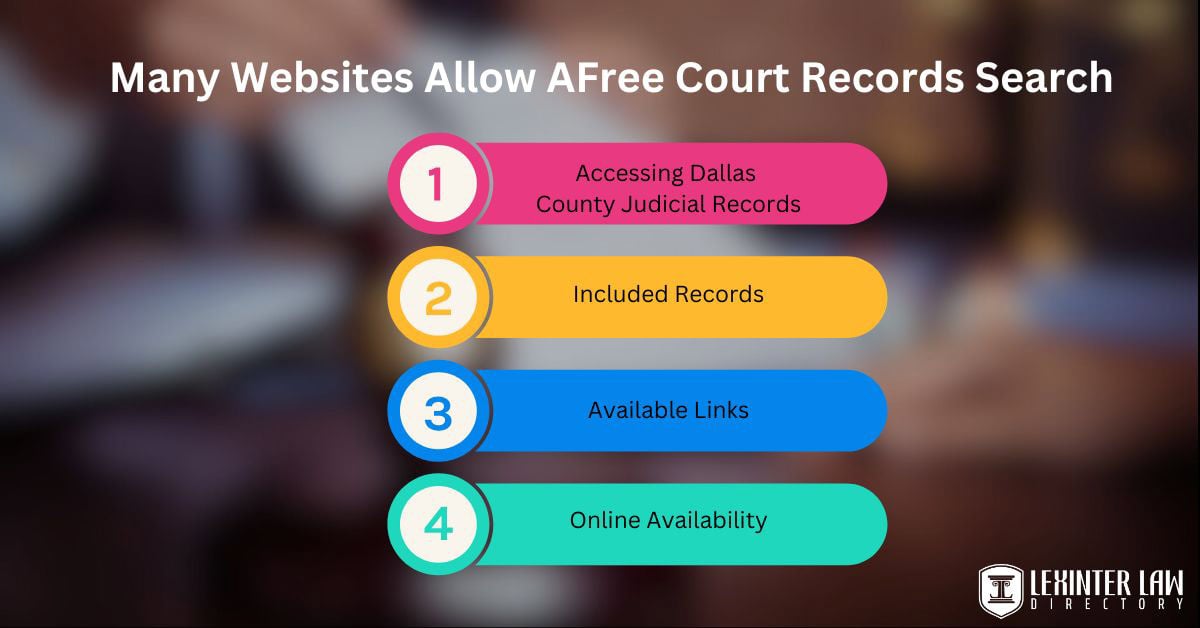
With the CountyOffice.org website as an example, Dallas County judicial records can be used to perform a free public court records search. This is a database that provides free access to government official websites, as well as public records and contact details in all 50 states.
The search will include things such as files, transcripts, court dockets, and more. The website contains real police records of felonies, mugshots, background reports, speeding tickets, sexual offenses, misdemeanors, and more. The Dallas County Court Records Search provides links to 3rd party websites that allow access to Dallas County judicial records. Some of these links will be –
City of Dallas Police Department Arrest Warrants
https://www.municipalrecordsearch.com/dallastx/Cases
You can search Dallas arrest warrants by name, docket number, citation number, or case number.
Dallas County Child Support Warrants
https://www.texasattorneygeneral.gov/child-support
Texas child support warrants list, including photos, names, and addresses
When the people of Dallas start investigating court records, they need to know where to go to get these free court records. They are also available online. They want to know what kind of court records are available, what civil case files are public, and how to actually perform court case and record searches.
Dallas County Judicial Records
Dallas County judicial records are all official documents created by the Police Department and the Dallas County Sheriff. In these documents, you will find names, birth dates, gender, and nationality. There will also be a description of your physical appearance. The documents will also contain fingerprints, mugshots, and any other criminal offenses, convictions, and arrest warrants associated with your name.
Dallas County judicial records are available at courts and law enforcement agencies. The County Clerk’s Office makes criminal records available to the public. Dallas County judicial records are available to the public in the paper- or electronic form.
The public can also visit the district court in Dallas and look for Dallas County judicial records at the Frank Crowley Courts Building at Riverfront Blvd, in Dallas. The Dallas County Sheriff’s Office also keeps criminal information and people can get Dallas County judicial records by contacting the Sheriff’s Office.
Dallas County Probate Courts
Dallas County is home to a robust probate court system designed to handle complex legal matters involving estates, guardianships, and trusts. Dallas County hosts three specialized statutory probate courts: Probate Court No. 1, Probate Court No. 2, and Probate Court No. 3. These courts have exclusive jurisdiction over probate matters, including wills, estates, guardianships, trusts, and mental health commitments. They also handle related civil cases such as fiduciary litigation, personal injury, and family law disputes connected to estates. Each court is led by an elected judge and supported by associate judges and staff. All three courts are located on the 7th floor of the George Allen Courts Building at 600 Commerce Street in Dallas.
Dallas County Civil Court Records

Dallas County civil court records are documents related to a civil case that is maintained by the federal court of jurisdiction. Most times Dallas County civil court records can be obtained by members of the public.
The records come from civil cases that involve matters such as divorces, and liens as well as other non-criminal court filings. Pleadings, motions, and trial transcripts are part of the civil record. The plaintiff files a complaint with the court.
The complaint has details about the plaintiff’s damages, provides details about how the defendant caused the damage, and asks the court to intervene. These are examples of Dallas County Civil court records and to avoid the expense of a trial, judges urge the litigants to reach an agreement. What about Dallas County mugshots?
Are these police photographs where a person is taken from the shoulders up after a person is arrested allowed to be looked at by members of the public? Dallas County mugshots belong to the government and are part of the public record. Police aren’t allowed to just post mugshots on social media. They can in some instances.
Publishing arrest Dallas County mugshots is available in most cities in Texas, including Dallas, and you will find small newspapers that publish mugshots.
In Dallas, for court records that have to do with misdemeanor cases, you can contact the Dallas County Clerk’s office or visit the office in the Frank Crowley Courts Building which is across from the District Clerk’s office.
Identify The Court Where The Case Was Filed
The first thing to do when you want records in Texas is to identify the court where the case was filed. You need to know that the Texas court system is divided into the trial and appellate courts.
Each of these 2 major courts is made up of other courts. So the appellate courts, for instance, will consist of the Supreme Court of Texas, the Court of Appeals, and the Court of Criminal Appeals, while the trial courts are made up of district courts, probate courts, justice courts, county courts, and municipal courts. Once you know which court to use, the next thing to do is contact the court’s record custodian. They are usually maintained by the Office of the Court Clerk for each of the individual courts.
The City of Dallas Public Information Office now has a web-based system for submitting and tracking open records requests, designed to increase citizen access to public information. It will make it much easier to request information.
They have a service request tracking system so that people can create their own profiles to get access to their requests in the future. Users will also be able to check the status of their requests and communicate with the open records group.
Dallas County District Attorney
Talking about the Dallas County District Attorney, John Creuzot currently serves as the district attorney. The mission of the District Attorney’s Office is to enhance public safety by supporting victims, holding offenders accountable, and fostering community trust. The Dallas County District Attorney is the chief legal officer and plays a critical role in the justice system.
County District Attorneys provide legal advice to government offices and decide whether or not to prosecute a case. They have significant decision-making power that can directly affect the community. They also determine whether criminal charges should be brought to court.
The District Attorney’s Office works closely with crime victims to pursue fair outcomes, always aiming to act in the public’s best interest. When a criminal charge is filed, the office initiates the process in a district court.
Criminal court records are generally open for public inspection, though certain records are sealed to protect sensitive personal information. This often includes documents involving juveniles or victims of particular crimes. Criminal courts maintain alphabetical name indexes to help locate filed cases, listing the person’s name, case number, and other relevant information. Each court manages its own index independently.
Online Portals Available For Judicial Records
Dallas County judicial records will be issued by a court in the county. The public can get information online and in person, and the County Clerk’s Office keeps court documents in Dallas County. The Clerk actually provides different online portals for searching Dallas County judicial records. The District Clerk also keeps records of Felony, Family, and Civil Courts in Dallas County.
Dallas County judicial records are totally free, although bear in mind that some public record search sites may charge a fee for what is known as premium content.
Enjoyed reading this article? If you did, then visit our blog to read more content on law schools, various branches of law, the judicial system of the United States, and much more.
