

Collin County Judicial Records: How To Get Them?
Collin County judicial records refer to official documents maintained by the courts regarding legal proceedings and case activities within Collin County, Texas. These records are publicly accessible and include a wide range of materials such as case filings, court rulings, exhibits, and supporting documents. Residents and legal professionals frequently seek access to these records for reasons including legal research, background checks, or simply staying informed on ongoing proceedings. However, while most court records are open to public view, certain documents, such as those involving juveniles, sealed cases, or specific family law matters, may be restricted.
Accessing these records has become more streamlined in recent years. The Collin County government’s website offers a robust online search portal where users can conveniently search court cases and request specific documents digitally. This system supports searches across various county courts, including district, county, and probate courts.
Located in the Blackland Prairie region of North Texas, Collin County sits approximately 34 miles northeast of Dallas and serves as a key component of the Dallas–Fort Worth Metroplex. As of 2025, the county’s population has soared to over 1.2 million residents, reflecting rapid urbanization and economic expansion. The county seat, McKinney, is a hub of legal, administrative, and civic activity.
Collin County is also recognized as a growing business epicenter, home to major employers such as Toyota Motor North America, Raytheon Technologies, Capital One, and JPMorgan Chase, all of which contribute to the region’s vibrant economy and increase the demand for legal infrastructure and services.
In this guide, you’ll learn exactly how to access judicial records in Collin County, including the tools and platforms available, the types of records you can request, and any legal limitations you should be aware of.
Table of Contents
All Kinds Of People Want Collin County Judicial Records
These Collin County judicial records are an important source of information for the judicial system. While they are mainly used by legal researchers and legal practitioners, often individuals are looking for information too.
Court records are made available through the court clerk’s office. Contact the court clerk for information on how to obtain copies of court documents. Depending on the court, you may need to contact the district clerk.
Most of the counties have online search options for court records from the different courts and some municipalities offer online access to judicial records for cases heard in municipal courts. The State Law Library also offers access to court records filed in the different courts and copies of court records are available at a small cost per page as well as other fees.
Electronic Court Records

With modern technology, most courts have adopted electronic systems to manage these court records. With court records going online, it means an efficient and organized way to manage records and to also access them. The computerization of Collin County judicial records does come with challenges, and even though the use of technology has reduced delays and improved efficiency, there are things that can go wrong.
Some court records are not open to the public. There would have to be a court order or some other special provision of the law to get them. Some of them are –
- Adoptions
- Income tax returns
- Certain marriage license information
- Emergency mental health evaluations
- Child in need of assistance cases
- Some financial statements
- Guardianship terminates parental rights
Citizens of Collin County want to know where and how to get hold of these Collin County judicial records. They need to know that there are both paper and electronic records. The courthouse keeps records of where the particular case was heard in both paper and electronic form.
Anyone can view these records in Collin County at the clerk’s office. But what more must you do to get hold of Collin County’s judicial records? You must provide the clerk with the case number for the court record you want to view.
If you do not have a case number, you should try and provide the clerk with the names of the people involved in the case and the clerk may then be able to locate the file. You can request a copy of the documents in the file. Bring some money along with you as there will be a fee for copies.
To save yourself from coming to the clerk’s office for nothing, you can always call the courthouse to ask if the record you want is in fact available. There are several court locations and phone numbers in Collin County.
The Different Courts
Texas and Oklahoma are the only states to have what is known as a bifurcated appellate system at the topmost level. You will get the Texas Supreme Court, which hears appeals concerning civil matters. The Supreme Court of Texas hears appeals regarding civil matters and not criminal matters.
There is the Court of Criminal Appeals which hears appeals in criminal cases. There is also the Court of Appeals of which the state has 14. There are a number of district courts of Appeals too. They have jurisdiction over felony cases. Then there are Probate Courts, Constitutional County Courts, Statutory County Courts at Law, Justice of the Peace Courts, and Municipal Courts.
In terms of electronic records in Collin County, civil and probate case files are often accessible remotely through the county’s online public records portal. However, criminal case records are generally only viewable in person unless a judge explicitly authorizes remote access due to high public interest. This is designed to safeguard sensitive case details and prevent unauthorized access to potentially confidential information.
As suggested, Collin County judicial records can be in paper or electronic format. Electronic records can only be viewed on an electronic device such as your tablet or computer. The public can look at Collin County judicial records, but there will be some that the public can’t see. When a child is removed from their parents or when a child is accused of a crime, these kinds of judicial records would not be available to the public.
Confidential records—such as those involving juveniles, child welfare, adoption, and cases sealed or expunged by court order—remain inaccessible to the general public. Access is usually limited to involved parties, legal counsel, and court-authorized entities. But, even though the public can’t have access to all records, there are people who are allowed, more so if you are involved in a certain case.
If you were aware of a criminal trial and wanted to look at electronic records about the case, you would need to visit the court to view the electronic records. In some instances where there is a lot of interest shown in a case, the judge will allow remote access to a criminal’s electronic record. However, some Collin County judicial records may be confidential by law or court order, and no one from the public would be able to view the electronic record.
Collin County Sheriff
At the Collin County Sheriff office, they believe that their duty is to serve and protect the citizens of the country. The sheriff is elected every 4 years. So what happens at the Collin County Sheriff office, because the sheriff is the chief law enforcement officer for the county.
It is the sheriff’s office that is responsible for operating the county jails, maintaining communication with other law enforcement organizations, and for investigating crimes. While the Collin County sheriff does have county-wide jurisdiction, most sheriff offices are involved beyond city borders where municipal officers do not have jurisdiction.
The Sheriff also accepts bail for prisoners in his custody, executes subpoenas, serves restraining orders, among others. The office of the sheriff in Collin County also operates a centralized sex offender registration office. The office monitors sex offenders living in the unincorporated areas of the county. For any animals being treated cruelly, the sheriff may also apply to a justice court for a warrant to seize these animals.
Collin County District Attorney
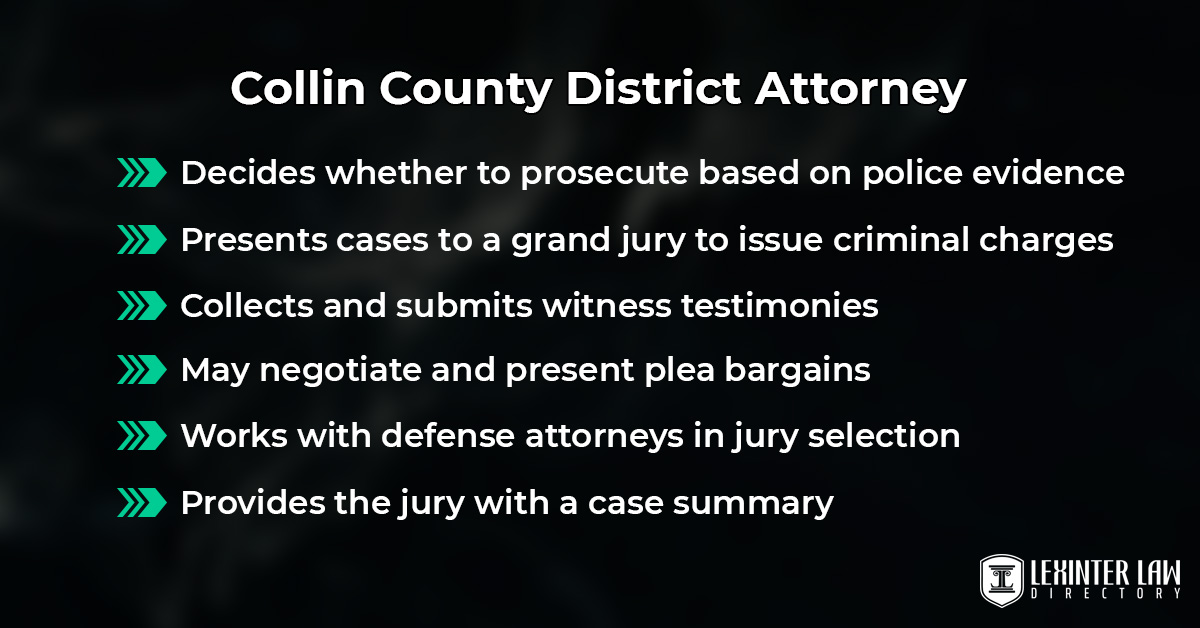
A Collin County District Attorney is kept busy representing the U.S. government in criminal cases that take place in local court or in the county. The Collin County district attorney is responsible for things such as recommending sentencing.
The district attorney in Collin County acts as the prosecutor in criminal cases. A district attorney has the authority to decide whether to prosecute an accused person or not. District attorneys first convene a grand jury before issuing a criminal charge.
The prosecutor collects witness testimonies and then gives them to the grand jury. Members then analyze the facts to determine whether to prosecute or not. District attorneys can then decide to negotiate with the defendant for a plea bargain. They can present the plea agreement to the jury to review the charges.
District attorneys decide whether they should go ahead with prosecuting based on the evidence presented by the police. They are also responsible for investigating activities before deciding whether to file a case against an accused person. Those district attorneys who appeal state-lost cases are called appellate attorneys.
They work with the defense attorney to select a jury. Once a jury has been formed, they receive a summary of the case. With so much leaning on a district attorney, they have to be well educated and have a Bachelor’s degree from an institution recognized by the American Bar Association.
Court Records At Different Law Enforcement Agencies
Collin County does not keep county-wide crime and arrest records. You will find these Collin County judicial records at different law enforcement agencies. The Sheriff’s office accepts requests from the public for these court records.
These include 911 recording CDs, accident reports, offense reports, and dispatch call logs. The Sheriff’s Office charges a fee for these records and accepts money orders, cash, and cashier’s checks. Requesters can submit an Open Records Request online through the Sheriff’s Office website or by downloading the official request form. The completed form can be mailed, submitted in person, or emailed to the records unit. The Collin County Sheriff’s Office is open to the public Monday through Friday, excluding county holidays.
If you are looking for Collin County judicial records, download the information request form, complete it, and hand it in at the Sheriff’s Office, which is open every day Monday to Friday.
These criminal records are official files that contain information about the crimes of people in the county. People wanting to access their criminal history record information need to schedule a fingerprint scan. This process must be done through the Texas Department of Public Safety (DPS) and can be scheduled online through the IdentoGO fingerprinting service.
The scan can be done online. The fingerprint hand card obtained will have other information such as the requester’s name, sex, date of birth, and race. Once the fingerprints are processed, individuals can request their criminal history record information from the Texas DPS, which provides the official statewide background check results.
Sex Offenders
The Collin County Sheriff’s Office also registers sex offenders. It makes the sex offender registry available to the public on its website. You can search for any of these sex offenders living in the county.
Police departments in Collin County also keep registries of sex offenders. The police department and the county sheriff’s office will send their lists to the Texas Department of Public Safety. You can find individual sex offenders by name in certain areas.
The Collin County Sheriff’s Office also keeps inmate records for everyone in the county’s jails. There is an inmate locator tool on its website to help find individuals. You can also locate inmates by using the Collins County Court search portals’ jail records page.
The online database only covers current and recent court cases, and if you are looking for a historical case, you can visit the district court clerk. These historical cases include all justice court, civil and probate court cases heard before 1984.
Collin County Court at Law Clerks charges something for record searches conducted at their office, but they do accept in-person and mail requests for these court record searches. You can visit or submit a written request to the County Court at the Law Clerk’s office in McKinney, Texas. Include the correct information, as well as a self-addressed envelope, and the search fee.
You can search online for Collin County judicial records, and this can be done free in District Courts by case number, attorney, case name, party, docket entry, judge, and more. You can filter cases further by date of filing, case type, jurisdiction, and more. So, if you want to request Collin County judicial records, you can submit a request by completing the request for judicial administrative records form.
Collin County’s website has many pages. The county however does not keep Police Records, 911 calls, or accident reports. These are kept as an example by the Sheriff’s office. Court records are kept by the courts themselves and can be accessed from the District Clerks criminal records County or District Courts. If you are looking for Collin County judicial records, they have a free app that will take you through many justice system databases with just one search.
