

State Specific Estate Planning Laws
Nearly everyone has an estate – your home, car, furniture, investments. Insurances and so on – everything you own. Estate planning is complex, and state specific estate planning laws can make it more complex as nothing is set in stone and the details can vary from state to state.
If you have an estate it is your duty to deal with your assets and see that they are all distributed the way you want. To do this properly you will need a will so that you can control how your assets are given to the people you care about.
To ensure that your instructions are carried out, estate planning comes into action – making a plan in advance.
Table of Contents
- State Specific Estate Planning Laws Can Differ
- Some People Can’t Comprehend The Same Forms But Different Terms
- Estate Planning Is Essentially Valid In Every State
- State Specific Estate Planning Laws – Differences Just Essentially Cause Delays
- New State – Time To Review Estate Planning Documents
- Key Components Of Estate Planning
- Common State-Specific Considerations
- How To Create A State-Specific Plan?
- Challenges In State-Specific Estate Planning
- FAQs
- Out-Of-State Executors Allowed
State Specific Estate Planning Laws Can Differ
State specific estate planning laws differ when it comes to estate and inheritance taxes, the rights of children to inherit, and the property rights of spouses. In fact, with each state, these laws can fall under various names or codes.
The different estate and probate codes include Decedents’ Estates, Estate Administration, Uniform Probate Code, and Trust and Fiduciaries. Code. There are a number of states that adhere to the Uniform Probate Code that represents an all-inclusive standard that is designed to simplify understanding how the probate process works. It encourages similarity of laws among the different states.
There are some people who are retired and who split their time between two states. Then, they need to be aware of certain state specific estate planning laws. Legally, it isn’t required for you to have separate estate planning documents for each state, but for some people, it can make sense.
The Constitution of the United States requires that states have respect for state specific estate planning laws, and this means that your will for instance, which may have been executed in one state should be honored in another state.
Some People Can’t Comprehend The Same Forms But Different Terms
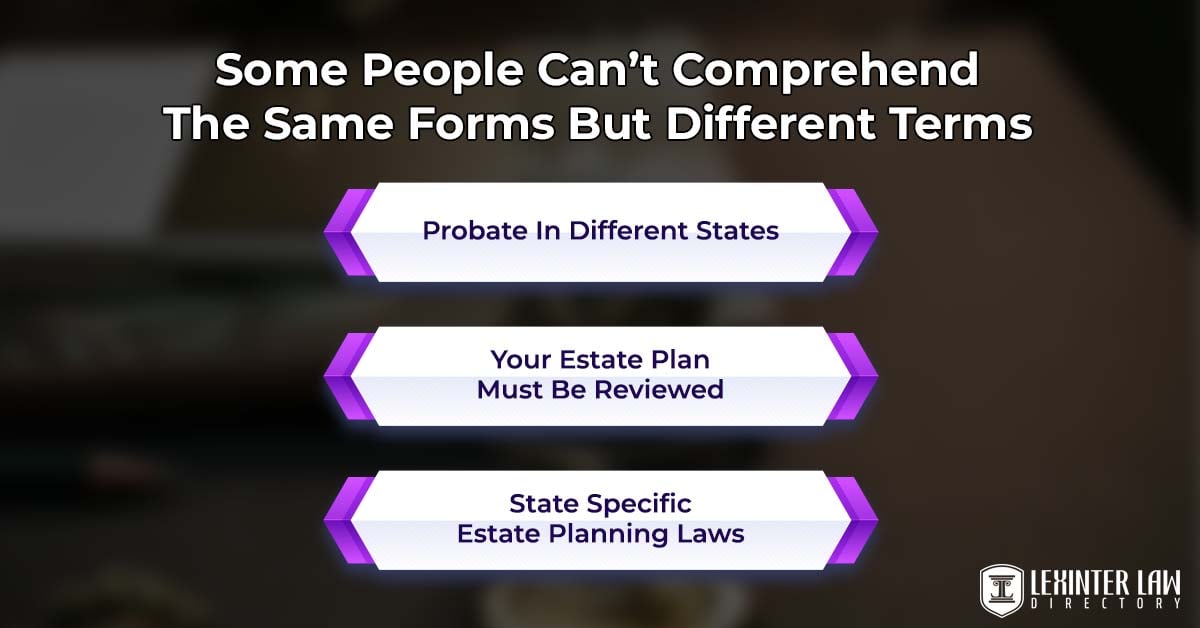
However, while you won’t need a separate will for a second state, your power of attorney may be something different. Financial and health care institutions are familiar with- and used to the documents used in their states and they may refuse to honor out-of-state documents.
People in these positions often refuse to comply with these new documents because they may use different terms and this is seen to complicate things.
In the absence of a power of attorney, family members often go to court to be appointed guardians, and this of course results in delays and legal fees. So, if you do spend time out-of-state, executing a local power of attorney may be a good idea.
Probate In Different States
Each state has its own allowed probate-avoidance methods. Many people want to avoid probate, and by creating a living trust, you can help your heirs avoid probate when you pass away.
There are online information and tips on how to create these living trusts online in a few easy steps. It a court-supervised process of settling a decedent’s estate, but you need to understand exactly why it can work out to be expensive and why you should avoid it and how to go about it.
Probate is another state, known as ‘ancillary probate’ which can amount to trouble and expense. The executor will quite likely need to find a lawyer in the new state to hand the probate.
With state specific estate planning laws, if you were to move to another state, it would be wise to make sure that your estate planning documents that were executed in one state will be recognized in your new state. You can always have your estate plan reviewed by an estate planning attorney in your new state.
Your Estate Plan Must Be Reviewed
Everyone needs to have an estate plan and review it every now and then to make provision for changes in individual circumstances and to cater for laws that may have changed. Certainly, when you move to a new state it is a good idea to think of having your documents reviewed by an estate planning attorney in your new home state.
This is because the laws governing the drafting and validity of the document vary from state to state. Each state has its own laws that govern the likes of trusts, powers of attorney, the legal validity of wills, and others.
These laws establish the legal requirements for estate planning documents. True, most of the states are adopting uniform laws governing trusts. This is known as the ‘Uniform Trust Code.’ There are still some states that haven’t adopted these uniform laws. Then state specific estate planning laws still apply to them as they have different laws governing these estate planning documents.
Also, each state has other indirectly related laws and these could also have an impact on your estate plan as regards estate taxes and other taxes, rights to marital property with a divorce, laws defining marriage, and the administration of estates among others.
Given the myriad ways in which state laws intersect with estate planning, seeking the guidance of an experienced estate planning attorney is crucial. They can help you navigate the complexities, tailor your estate plan to your specific circumstances, and ensure your assets are properly distributed while minimizing potential legal challenges.
State Specific Estate Planning Laws – Different States Could Mean Delays
Estate planning documents drafted in another state may well be recognized by your new home state, however, the new state’s laws on your estate planning documents may result in consequences that delay things at a time when you need to be relying on them.
Also, the laws that govern estate plans are always changing so every estate plan needs to be reviewed from time to time to address these changes. An estate plan isn’t standard and constant. It is something that is constantly changing and evolving and therefore these changes make reviews of your estate planning documents important, more so when you move to a new state.
Estate planning is a lifelong thing – an ongoing process, and you need to be looking at it as your life and circumstances change over your lifetime.
Estate planning documents are definitely impacted by a move to a different state from the state where the documents were actually drafted. Everyone with an estate will need to check out their state specific estate planning laws and consult with financial advisors such as tax advisors to see what the tax implications are.
How can a lawyer help? An estate planning lawyer offers assistance in creating, reviewing, and executing the legal documents necessary to align your estate plan with your wishes while ensuring legal validity. They tailor these documents to your unique needs, accounting for family dynamics, financial situations, and goals.
With expertise in complex legal frameworks, including federal and state laws, tax codes, and probate regulations, lawyers navigate intricacies to avoid mistakes and maintain document legality. By preparing wills, trusts, powers of attorney, healthcare directives, and more, they establish guidelines for asset management, decision-makers, and medical preferences.
Lawyers minimize estate and inheritance taxes, especially in cases involving complex assets like businesses, multiple-state real estate, or international holdings. They also keep your plan updated as life changes occur. When you pass away, lawyers guide loved ones through probate and asset distribution, while adhering to legal formalities. They can also provide dispute resolution if conflicts arise.
Estate Planning Is Essentially Valid In Every State
People are inclined to think that estate planning is only for wealthy people and businesses, but it’s for those with few assets as well. With a lack of mental capacity, your family may not receive the few assets they deserve to receive. Then the court steps in and controls how your assets are used for your care through guardianship.
It can work out to be expensive and also time-consuming. If you die without an estate plan, assets owned by you will be distributed according to your state’s intestacy laws. It is better to have your estate matters handled privately and not by the courts.
When it comes to state specific estate planning laws, what actually happens if you move to another state? Do all your estate planning documents count for nothing? A lot went into their planning and preparation and you no doubt hired an attorney to help you.
It seems ludicrous that just because there are state specific estate planning laws, that you have to start over with the estate planning documents. Many people don’t want to risk the chance of having documents that don’t meet the legal requirements when they move to a new state and they do about getting a new set of documents.
State Specific Estate Planning Laws – Differences Just Essentially Cause Delays
If you prepared a will in your old state, it will in all likelihood be valid in your new state, too. But having said that, out-of-state will do pose some problems. If you’re married and move from a community property state to a common law state or the other way around, the rules with regards to what you can own can change.
In community property states, married couples own everything together. In other states, however, it could be that each spouse takes whatever is in their name. This means that if you were to move to a community property state, your property will be treated as if was bought in the community property state.
A revocable living trust doesn’t adhere to the same rules as a will and it should be valid in any state, regardless of where you signed it.
It is always important to make sure that your living trust, power of attorney or will document are in compliance with your new state’s laws otherwise you may find that they don’t perform the way they are supposed to.
There are some key differences in the different states. Your estate plan does likely consist of powers of attorney for financial decisions. Estate plans are drafted according to the laws where you lived first and not your new state and these laws affect your inheritance tax.
New State – Time To Review Estate Planning Documents

What might have been a good plan then may not be as good in your new state. Look at the age of your estate plan, because regardless of relocation, it is always best to review your plan every few years, especially when there have been some major changes in your life.
Even with state specific estate planning laws, an attorney may want to interpret your document but won’t necessarily have the experience of the laws that existed in the state that you come from. Forms and authorizations are different, and it could be that even those terms that appear the same may have different legal meanings.
Medical Care
Take a look at your medical care as health care powers of attorney do differ between the different states. Medical personnel will probably only be familiar with their state’s forms. If you aren’t able to share your medical information, your agent’s authority could encounter all kinds of delays because of different documents.
In fact, legal counsel may even have to confirm your documents’ validity and this could imp[act on the care you need. You may even have nominated certain individuals to act for you for medical and estate matters. Geographically, important decisions surrounding your medical care may become slow, time-consuming, and troublesome. Also, some states don’t allow non-resident executors and in fact, there are only a few states that do allow this. Other states impose other requirements.
Marital Property Laws
Marital property laws are all about determining the division of assets between spouses. There are a few states that recognize the property as community property, treating all assets acquired during the marriage as owned by both spouses.
Then again, other states recognize common law property – each spouse’s property is owned by the specific person. Community property may be more beneficial at death for income tax purposes, but you have to consider all these things when moving to a new state.
Property Titling
If you have moved to a new state, check out what state specific estate planning laws exist. Certainly, a new attorney will review the titling of your assets, and depending on your circumstances, it may be more beneficial to transfer title to the name of your trust. Certain titling may not be the same across the different states and could impact the distribution of your property when you die.
Some states have certain property laws that can be impacted by your estate planning. Florida’s homestead laws as an example could override your estate plan. At your death, you will be required to distribute your primary residence to your spouse and children.
Property deeds are legal documents that transfer ownership of the property to the buyer. For a deed to be legal it has to state the name of both seller and buyer.
Events or changes in circumstances create a need to update estate planning. Estate planning laws aren’t national and state-specific estate planning laws that apply to each state. Some of the differences can be quite substantive and there are quite a few states that require a spouse to inherit a minimum share of the estate, but the requirement varies between the states.
Also, there are those states that have estate- or inheritance tax while others don’t. State laws vary with other things too, such as powers of attorney, and if you move, these documents will need to be updated for your new state.
Key Components Of Estate Planning
Estate planning involves several essential components. These components help ensure that your assets are distributed according to your wishes. They also provide legal clarity for your loved ones. Understanding each part of estate planning is crucial for making informed decisions. Here are the key components that make up a complete estate plan. Each serves a unique purpose and is vital to your overall plan.
Wills And Probate Process
A will is a legal document that explains how you want your assets distributed after your death. It can also name a guardian for your children. Without a will, the court decides how to distribute your property based on state laws.
The probate process is the legal procedure that validates a will and settles the estate. While it ensures your wishes are followed, probate can be time-consuming and expensive. Proper planning can simplify or avoid this process.
Trusts For Asset Protection
Trusts are tools that allow you to transfer your assets to a trustee for the benefit of your beneficiaries. A living trust can help you avoid probate and ensure privacy. Trusts are also used to protect assets from creditors or lawsuits. They are flexible and can be tailored to meet your specific needs. With a trust, you maintain control over how and when your assets are distributed. This makes them a popular choice in estate planning.
Powers Of Attorney
A power of attorney allows someone to act on your behalf for financial or legal matters. This is important if you become unable to make decisions yourself. You can choose a trusted person to manage your bank accounts, pay bills, or handle other tasks. There are different types of powers of attorney, such as durable or limited. Ensuring you have this document in place can prevent family disputes and delays in managing your affairs.
Advance Healthcare Directives
An advance healthcare directive outlines your medical wishes if you cannot communicate them. It may include a living will, which specifies the type of care you want or do not want. It can also appoint a healthcare proxy to make medical decisions for you. This document ensures that your wishes are respected during a medical emergency. Having an advance healthcare directive can bring peace of mind to you and your loved ones.
Beneficiary Designations
Beneficiary designations determine who will receive assets from accounts like life insurance policies, retirement funds, or bank accounts. These designations often override what is stated in your will. It is important to keep these up to date, especially after major life events like marriage or divorce. Ensuring accurate beneficiary designations can avoid confusion and disputes. This simple step is a critical part of estate planning that ensures a smooth transfer of assets.
Common State-Specific Considerations
Estate planning laws can vary greatly from one state to another. Understanding these differences is essential for creating a plan that works in your state. Each state has unique rules that can impact how your assets are managed and distributed. From inheritance laws to Medicaid regulations, these state-specific considerations play a critical role in estate planning. Here are some common areas to consider when planning your estate in a specific state.
Intestate Succession Laws
Intestate succession laws govern how your assets are distributed if you die without a will. These laws vary by state and determine who inherits your property. Typically, assets go to your closest relatives, such as a spouse, children, or parents. However, the rules differ depending on your state’s specific laws. For example, some states may give more to a surviving spouse, while others split assets equally among children. Understanding these laws can help you plan better to avoid unwanted outcomes.
Homestead Property Protections
Homestead property laws protect your primary residence from creditors in certain states. These protections may also provide tax benefits or shield your home from being sold during probate. However, the extent of these protections varies by state. Some states have strong homestead laws, while others offer limited or no protections. These laws are especially important for families who wish to preserve their homes. Consulting an attorney familiar with your state’s laws can help you understand your rights.
Guardianship Rules For Minors
Each state has different rules for appointing guardians for minor children if both parents pass away. A will allows you to name a guardian, but state laws determine how this process is carried out. Some states require court approval for guardianship appointments. Others may have specific rules about who can serve as a guardian. Understanding your state’s guardianship laws ensures your children are cared for according to your wishes. It also prevents unnecessary legal complications.
Digital Asset Planning
State laws on digital assets, such as online accounts and cryptocurrencies, are still evolving. Some states have adopted laws to give executors access to these assets, while others have not. Without proper planning, your digital accounts may be inaccessible to your loved ones after your death. Including digital assets in your estate plan ensures they are properly managed and distributed. State-specific rules on digital asset access can vary, so consulting an expert is essential.
Medicaid Asset Protection Rules
Medicaid rules differ by state and can significantly affect how you protect your assets. Some states have strict guidelines for qualifying for Medicaid benefits, including long-term care. Others may allow more flexibility in asset transfers or exemptions.
Planning for Medicaid involves strategies like setting up trusts or re-titling assets to meet eligibility requirements. Understanding your state’s Medicaid rules can help you preserve your wealth while accessing necessary healthcare benefits.
How To Create A State-Specific Plan?
Creating an estate plan tailored to your state’s laws is essential to ensure your wishes are honored. Since estate planning laws vary across states, it’s important to account for these differences. From consulting professionals to keeping your documents updated, there are specific steps to follow. A well-prepared plan can minimize complications for your loved ones. Here are practical steps to create a state-specific estate plan.
Consult An Estate Planning Attorney
An estate planning attorney understands the specific laws in your state and can provide expert advice. They help draft documents like wills, trusts, and powers of attorney that comply with local requirements. An attorney also ensures your estate plan reflects your unique needs and goals. When you’ve moved to a new state, they can review and adjust your existing plan. Consulting a local attorney is the best way to avoid legal complications.
Research State-Specific Laws
Learning about your state’s estate planning laws helps you understand how they impact your plan. Each state has its own rules for probate, inheritance taxes, and marital property. Researching these laws helps you make informed decisions about your assets. Online resources and legal guides can provide a starting point. However, working with a professional ensures you don’t miss critical details that could affect your estate plan.
Update Documents For New Laws
Estate planning laws change over time, and your documents need to stay current. This is especially important if you’ve moved to a new state or if your state has passed new regulations. Documents like wills, trusts, and healthcare directives must comply with the latest legal requirements. Updating these documents ensures they remain valid and enforceable. Regular updates also reflect changes in your personal or financial situation.
Use State-Approved Templates
Some states provide official templates for estate planning documents, such as wills and powers of attorney. These templates are designed to meet the state’s legal standards and can simplify the planning process. Using state-approved forms reduces the risk of your documents being invalidated. However, templates may not cover complex situations. It’s always a good idea to have an attorney review any templates to ensure they fit your specific needs.
Regularly Review And Revise Plans
Life changes, such as marriage, divorce, or the birth of a child, can affect your estate plan. Additionally, state laws may change over time. Regularly reviewing your estate plan ensures it remains effective and aligned with your current circumstances. Experts recommend reviewing your plan every three to five years or after major life events. This practice keeps your plan up to date and minimizes potential conflicts in the future.
Challenges In State-Specific Estate Planning
State-specific estate planning can be challenging due to the variation in laws and regulations across states. These challenges can create complexities that require careful consideration and expert advice. Issues such as relocating, outdated documents, and handling multi-state properties can complicate the process. Understanding these challenges helps in creating a more effective and legally sound estate plan. Here are some of the common challenges people face in state-specific estate planning.
Relocating Between States
Moving to a new state can disrupt your existing estate plan. Different states have unique laws that may conflict with your current documents. For example, marital property laws, probate rules, and healthcare directives vary significantly.
Relocation may require updating your will, trust, and powers of attorney to align with your new state’s regulations. Failing to address these changes can lead to delays and legal complications. Reviewing your estate plan after a move is essential.
Conflicts With Federal Laws
While estate planning is primarily governed by state laws, some aspects intersect with federal regulations. For instance, federal tax laws may conflict with state inheritance tax rules. Medicaid planning is another area where federal guidelines must be balanced with state-specific requirements.
Navigating these conflicts requires careful planning and professional guidance. An estate planning attorney can help ensure your plan complies with both state and federal laws.
Outdated Estate Planning Documents
Estate laws frequently change, and outdated documents may no longer be valid. For example, a power of attorney drafted in one state may not be accepted in another. Similarly, changes in state tax laws or probate processes can affect how your assets are distributed. When your documents are not updated to reflect current laws, they may lead to disputes or delays. Regularly reviewing and updating your estate plan is crucial to avoid these issues.
Variations In Executor Qualifications
Each state has specific rules about who can serve as an executor of an estate. Some states require executors to be residents, while others may allow out-of-state executors but impose additional requirements. For instance, certain states mandate that out-of-state executors appoint a local agent to accept legal documents.
These variations can complicate the administration of your estate if the chosen executor does not meet the qualifications. Selecting an executor who complies with your state’s laws is important.
Handling Multi-State Property Ownership
Owning property in multiple states adds complexity to estate planning. Each state may have its own rules for transferring property, and this often requires separate probate proceedings. These additional legal steps, known as ancillary probate, can be time-consuming and costly. Creating a living trust can help avoid this problem by streamlining the transfer of property across state lines. Consulting an attorney familiar with multi-state property laws is key to managing this challenge effectively.
FAQs
1. Can State Laws Override Federal Estate Planning Rules?
No, state laws cannot override federal estate planning rules. However, federal laws, such as those on taxes, work alongside state laws. Each governs different parts of estate planning. For example, federal estate tax laws apply nationwide, while states may have their own rules for probate or inheritance taxes.
2. How Do State Laws Impact Spousal Rights In Estate Planning?
State laws determine how much a spouse can inherit, even if the will says otherwise. In community property states, spouses share ownership of property acquired during marriage. Other states use common law rules, where assets belong to the person named on the title. These laws can affect how estate is divided.
3. Do State Laws Impact Estate Planning For Non-citizens?
Yes, state laws can impact non-citizens in estate planning. Non-citizens may face different inheritance tax rules or restrictions on owning certain properties. Some states may have unique probate rules for foreign heirs. Consulting an attorney helps ensure compliance with both state and federal regulations.
Out-Of-State Executors Allowed
As already mentioned, if you have an estate plan, it is recommended that you review and revise your estate plan every 3 years. Also, make sure that the executor you have chosen can serve in your new state. Most states do allow out-of-state executors, but they may have special requirements that need to be fulfilled.
There are some states that require an out-of-state executor to appoint an in-state agent in order to accept legal documents for the estate. These executors step in and see to all the person’s arrangements.
